Match on action
- Occurs when an action that begins in one shot is continued or completed in the next shot. In an exterior shot a person opens the front door to a house. In the next shot the camera, now interior, photographs the person entering the foyer and closing the door. We shown this when tony walks through from the corridor and we then show him entering inside the room.
The 180° rule
- Is a basic guideline in film making that states those two characters
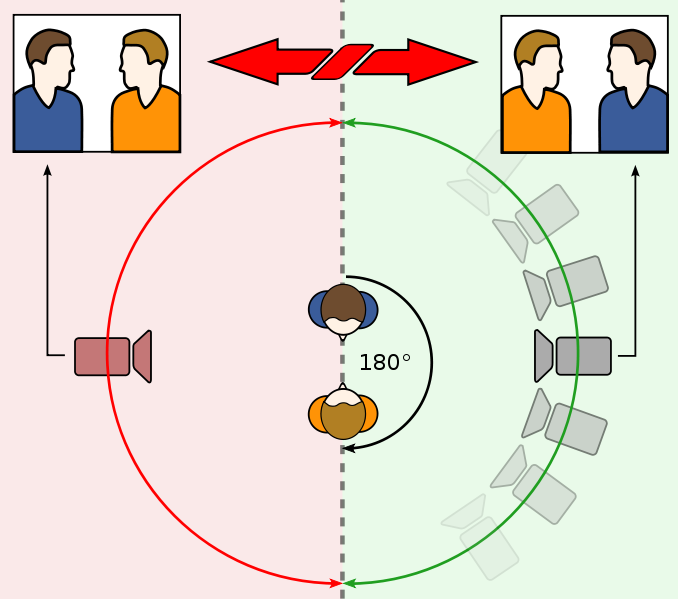 (or other elements) in the same scene should always have the same left/right relationship to each other. If the camera passes over the , it is called crossing the line. The new shot, from the opposite side, is known as a revimaginary axis connecting the two subjectserse angle. In the example if Jack(orange shirt in the diagram) is on the left and Bob (blue shirt) is on the right, then Jack should be facing right at all times, even when Bob is off the edge of the frame, and Bob should always be facing left. Shifting to the other side of the characters on a cut, so that Bob is now on the left side and Jack is on the right, will disorient the viewer, and break the flow of the scene.
Shot/Reverse Shot
- This is when one character is shown looking at another ch
 aracter (often off-screen), and then the other character is shown looking "back" at the first character. Since the characters are shown facing in opposite directions, the viewer assumes that they are looking at each other. This is then shown in our filming when Tony and Kiel is having a conversation whilst sitting down on the chairs at the table.
As well as researching the specific shots that were used in the preliminary, I also researched all of the other kinds of shots that can be used. For example
Crab shot – when the camera moves completely to left or right aka tracking sideways.
Panning Shot – the camera pivots left or right but stays in the same spot
Tilt – the camera moves up and down
Boom – camera moves up or down ie; in a lift

Dolly shot – camera moves in and out from the shot, this can also be called tracking in and out.
The preliminary exercise was a good chance for me to try to get used to the camera shots which I was never familiar of and getting used to filming using the tripod and the camera which was all very new to me as well as the rest of the group. When filming, it was hard to ensure that the shot was good enough. This was because we found that the sound wasn’t loud enough and many problems occurred. However this wasn’t noticed until me and my group came to editing. By seeing the shots that were taken on a large screen and trying to straight cut one shot to another made us realise that when filming when on and off film you need to ensure the continuity is the same because otherwise the editing becomes very obvious and doesn’t look professional in anyway.
However despite these problems we kept with the first lot of shots that was taken as we could use this as a learning curve as it was all of me and my groups first time to become familiar with the film language and camera shots as well as the editing software which was difficult to work with at first but eventually we managed to familiarise ourselves with it. The editing software that was used was Adobe Premiere Pro.
If we filmed this again I think that we would use more use out of the tripod rather than hand holding the camera as the camera wasn’t still in some shots. Also would take more shots of the same thing as we saw when it comes to editing not all the clips are as good as you hoped them to be. So by taking many various shots this enables you to have a variety and can replace the bad shots with good ones if the editing has been done correctly to make it look like one clip rather than two different ones. By this we shall be taking this into consideration when it comes to filming our next project.
